Opening Conversations About Gambling Risks: Sentence Starters and Frameworks for School Staff
 Save
Starting a conversation about gambling risks in a school setting means creating a space where pupils feel comfortable asking questions without judgement. Teachers and pastoral staff can use sentence starters and discussion frameworks tailored to different age groups, helping young people recognise the difference between entertainment and harm. This guide gives you practical language and structures for whole-class discussions, one-to-one conversations and PSHE sessions, along with follow-up steps when a pupil discloses a concern. Transformation Trust supports educators in addressing gambling harm through clear, accessible information.
Why School-Based Conversations Matter
Young people encounter gambling content through adverts, social media and gaming platforms long before they turn eighteen. Schools offer a structured environment where staff can explain the risks in a way that feels less personal than a parental conversation, and where pupils can hear from peers. Opening the topic early normalises help-seeking and gives young people language to describe what they see online.
Gambling harm affects concentration, mood and relationships, all of which teachers observe in the classroom. A conversation in a PSHE lesson or tutor time can prevent a problem from deepening, and it signals that the school is a place where difficult subjects are discussed openly. Many young people will not raise the issue themselves, so staff-led conversations are often the first time the subject is named.
Sentence Starters for Different Age Groups
Key Stage 3 (ages 11–14)
At this stage, pupils are becoming aware of gambling through football sponsorships, YouTubers and game mechanics that mimic betting. Your language should introduce the concept without assuming prior experience:
- "Has anyone noticed adverts for betting during football matches? Let's talk about what those companies are selling."
- "Some games use loot boxes or spins that feel like winning a prize. What makes that exciting, and when might it start to feel like a problem?"
- "Gambling means risking money or something valuable on an uncertain outcome. Where have you seen that happen, online or offline?"
- "If someone kept playing a game hoping to win back what they lost, what might happen next?"
Keep examples concrete and linked to their world. Avoid lecturing; instead, ask open questions that let pupils share observations.
Key Stage 4 (ages 14–16)
Older pupils may have direct or indirect experience of gambling, through their own activity or a family member's. Your starters can be more direct and invite personal reflection:
- "Some people say gambling is just a bit of fun. When does it cross the line into something that causes harm?"
- "Imagine a friend is spending their lunch money on scratchcards. What would you say to them, and where could they go for help?"
- "Gambling sites are for over-eighteens, but we know some young people find ways around age checks. What risks does that bring?"
- "Has anyone seen betting tips or predictions on social media? Let's talk about how influencers make money from those posts."
At this age, pupils respond well to scenarios that put them in the role of advisor or friend, rather than being told what not to do.
Key Stage 5 (ages 16–18)
Sixth-formers are close to legal gambling age and may already be using betting apps or engaging with skin betting on gaming platforms. Your approach can acknowledge this reality while focusing on informed choices:
- "In a few months or years, gambling will be legal for you. What do you already know about how it works, and what do you wish you knew?"
- "Let's talk about the tools gambling sites are required to offer—deposit limits, time-outs, self-exclusion. Why do those exist, and when would someone use them?"
- "If you're betting on esports or trading skins, that's gambling even if no money changes hands at first. What happens when it does?"
- "Financial harm is one side of gambling problems. What about the effects on mental health, relationships or studies?"
Treat these pupils as near-adults who can engage with complexity. They benefit from understanding the industry's business model and the psychology behind product design.
Frameworks for Whole-Class Discussion
A discussion framework gives structure to a conversation that might otherwise drift or become too abstract. Choose a framework that suits your class size, the time available and the level of trust already established.
The Spectrum Line
Draw an imaginary line across the room, with one end representing "no risk" and the other "serious harm". Read out scenarios—someone buys a lottery ticket once a year, someone bets on every football match, someone spends money on loot boxes in a game—and ask pupils to position themselves along the line. Discuss why they chose that spot. This makes risk visible and shows that not all gambling carries the same level of concern.
Think, Pair, Share
Pose a question such as "Why might a young person start gambling online?" Give pupils a minute to think alone, then pair them to discuss, then invite pairs to share with the class. This structure lets quieter pupils contribute without being put on the spot, and it generates a wider range of answers than asking the whole group at once.
Case Study Discussion
Present a short written scenario: a fictional young person who has started gambling, the signs their friends noticed, and a decision point. Ask small groups to discuss what the person should do next and which adult they should talk to. Bring the groups back together to compare their advice. Case studies remove the personal element while still addressing real consequences.
One-to-One Conversations with Individual Pupils
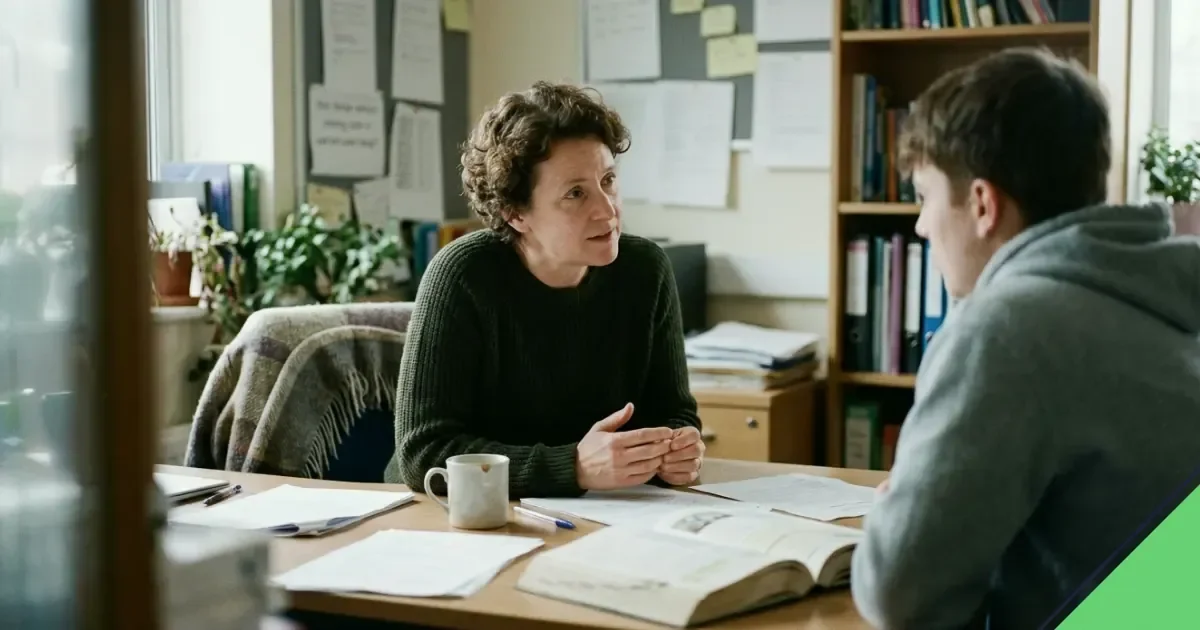
When a pupil discloses gambling activity or you suspect a problem based on behaviour changes, a private conversation requires different language. Your goal is to listen, not to interrogate, and to leave the door open for follow-up.
- Open with a neutral observation. "I've noticed you've seemed a bit distracted lately. Is there something on your mind you'd like to talk about?" Avoid leading with "Are you gambling?"—the pupil may not use that word themselves yet.
- Name what you've seen, not what you suspect. "You mentioned needing money for something last week, and today you seemed upset after checking your phone." Describe behaviour, not character.
- Ask an open question. "Can you tell me what's been going on?" Let the pupil set the pace. Silence is acceptable; resist the urge to fill it immediately.
- Normalise help-seeking. "Lots of people need support with gambling at some point. It's a sign of strength to talk about it, not weakness."
- Explain the next steps clearly. "I'm going to speak to our safeguarding lead so we can work out the best way to support you. That might involve talking to your parents or connecting you with a specialist service."
- Give the pupil control where possible. "Would you like to be in the room when I speak to them, or would you prefer I do it alone first and then we meet together?"
Document the conversation according to your school's safeguarding policy. If the pupil has debts or has accessed inappropriate content, a safeguarding referral may be necessary. Understanding the steps to take when a young person has gambling debts can help you advise parents on the practical side.
Handling Difficult Responses
Not every pupil will engage constructively. Some may dismiss the topic as irrelevant, others may become defensive if they feel judged. Your response sets the tone for whether they return to the conversation later.
If a pupil says "It's just a bit of fun": Acknowledge that gambling can be entertaining, then ask what would change their view. "What would make it stop being fun? When have you heard of someone losing more than they could afford?" Move from the general to the specific without making it personal.
If a pupil shuts down: Respect their boundary but leave the door open. "I can see this isn't something you want to talk about right now. If that changes, I'm here, and there are confidential helplines too." Give them a printed card with contact details.
If a pupil deflects with humour: Join lightly, then pivot. "Yes, it does sound a bit boring compared to other topics. But knowing how to spot a problem early—whether it's yours or a friend's—could matter one day." Humour can be a defence; meet it without escalating.
Embedding Conversations Across the Curriculum
Gambling risks do not belong only in PSHE. Maths lessons can explore probability and the house edge. Computing classes can discuss algorithms and targeted advertising. Media studies can analyse sponsorship deals between betting companies and sports teams. Embedding the topic across subjects reinforces that it is a real-world issue, not a one-off lecture.
In English, pupils might analyse the language of gambling adverts or read a text where a character faces financial pressure. In citizenship, they could debate whether gambling advertising should be restricted. Cross-curricular work makes the subject feel less like a warning and more like a critical-thinking exercise.
Supporting Colleagues Who Feel Unprepared
Not every teacher feels confident discussing gambling harm, especially if they lack training or worry about saying the wrong thing. A whole-staff briefing can equip colleagues with the basics: what gambling harm looks like in young people, where to signpost for help, and how to handle a disclosure.
Share sentence starters and frameworks at a staff meeting. Role-play a disclosure scenario so that colleagues can practise their response in a low-stakes environment. Designate a lead member of staff—often someone in pastoral care—who can offer advice when a colleague is unsure. Teaching gambling risks across PSHE and pastoral care provides further strategies for whole-school approaches.
Tools and Frameworks to Share with Pupils
| Tool | What It Does | Who It Suits |
|---|---|---|
| Deposit limits | Caps how much someone can add to a gambling account in a set period | Anyone gambling online who wants to stay within a budget |
| Time-outs | Blocks access to a gambling account for a chosen period, from hours to weeks | Someone who wants a short break to regain perspective |
| Self-exclusion | Prevents access to a gambling site or all licensed sites for months or years | Someone who recognises they need a longer break or has experienced harm |
| GAMSTOP | Free national scheme blocking access to all licensed gambling sites at once | Anyone over eighteen in the UK who wants comprehensive protection |
Explain these tools in a lesson so that pupils know they exist before they need them. Emphasise that using a tool is not an admission of failure; it is a practical step to stay in control.
When to Involve Parents and Carers
Deciding when to contact a parent depends on the severity of the concern and the pupil's age. If a young person has disclosed gambling activity but shows no immediate harm, you might agree with them that they will talk to a parent first, with school support if needed. If there is financial harm, safeguarding concerns or a pattern of escalation, you must inform parents as part of your duty of care.
Prepare parents for the conversation by sending a brief letter or email first, outlining what you have observed and offering a meeting. Some parents may react defensively or dismiss the concern; others may be relieved that someone else has noticed. Your role is to inform and support, not to blame. Pointing parents towards support services for young people affected by gambling gives them a next step beyond the meeting.
Getting Help and Further Support
If a pupil needs specialist advice or you are unsure how to respond to a disclosure, several organisations provide free confidential support for gambling harm. GamCare operates the National Gambling Helpline on 0808 8020 133, available every day of the year. The helpline is free, and staff can talk through concerns with young people, parents or professionals. You can also visit GamCare for webchat and email support.
BeGambleAware offers resources and information at BeGambleAware.org, including advice on spotting harm and starting conversations. Gordon Moody, found at Gordon Moody, provides residential and online treatment for people affected by gambling. All these organisations work with schools and families, and none requires payment.
Gambling is for people aged eighteen and over. If a pupil under that age is gambling online, that is a safeguarding matter. Schools should record the concern, inform parents and consider whether further referral is needed.
This article is for general information only. Transformation Trust is an independent information site for people affected by gambling harm and does not provide gambling products or services. Support is available through the organisations named above, and all advice given here is intended to help educators open conversations, not to replace specialist training or professional guidance.
#Classroom discussion #Conversation starters #School policy #Safeguarding
Further reading
Frequently asked questions
How do I bring up gambling risks without making pupils feel accused?
Start with a general question or observation about gambling in the media, gaming or sport, then invite pupils to share what they have noticed. Framing it as a discussion about how gambling works, rather than assuming anyone in the room is affected, keeps the tone open and lets young people engage without feeling singled out.
What should I do if a pupil discloses gambling activity during a lesson?
Acknowledge their honesty, thank them for sharing and arrange to speak privately after the lesson. Follow your school's safeguarding procedures, document the disclosure and inform your designated lead. Depending on the severity, you may need to involve parents and signpost the pupil to specialist support such as GamCare.
Can I discuss gambling in a subject other than PSHE?
Yes. Maths lessons can explore probability, computing can cover targeted advertising, and English can analyse the language of betting adverts. Embedding the topic across the curriculum reinforces that gambling harm is a real-world issue, not just a one-off personal and social education topic.